
Current production-control commitment
Quality from cultivation to delivery
Know what you are buying—and what supports it.
We connect cultivation controls, route-specific processing and batch testing so your team can evaluate each Dunaliella ingredient with the right information.
- Cultivation control
- Route-specific processing
- Batch-specific evidence


Quality definition
What is code-specific ingredient qualification?
Ingredient qualification is a code-specific review that compares a defined Product Specification with the test results for an identified batch and the scope of applicable certificates. A specification states release limits; a COA records measured results for one batch; an SDS / MSDS supports safe handling; and a certificate applies only within its stated scope. These documents answer different questions and should not be substituted for one another.
- Requirement
- Current Product Specification for the selected code
- Batch evidence
- COA for an identified production batch
- Scope evidence
- SDS / MSDS and applicable controlled certificates
- Evidence owner
- Technical review by HETCHYN Quality & Technical Teams
Supercritical CO₂ oil grades
Identity, potency, metals and microbiology
How to read the quality documents
Specification, COA and certificate: each tells you something different.
A specification sets the requirements, a COA reports results for one batch, and a certificate defines its own scope. Keeping them separate makes product review clearer.
What must the selected SKU meet?
Defines the applicable parameters, test methods and release limits for a product code. It is the requirement used for release, not a measured result for every future batch.
Example: DS-DP8-JZ total arsenic release limit ≤1.0 mg/kg.What did one identified batch measure?
Reports measured results for one named batch against its specification. It supports initial review but is not a multi-batch average or a promise for a future batch.
Example: DS-DP8-JZ batch 2026071202 reported 0.40 mg/kg total arsenic on 24 July 2026.What system or product scope is covered?
Shows the credential, issuing context and stated scope. Applicability must be checked against the selected product and current controlled certificate.
Example: the self-affirmed GRAS assessment applies to Dunaliella salina powder, not automatically to every format.- Evidence owner
- HETCHYN Quality & Technical Teams
- For current documents
- Request the current approved Spec, COA, SDS / MSDS and applicable certificate by product code.
Low-arsenic powder
Low total arsenic starts with how the algae is grown.
HETCHYN's enclosed glass-greenhouse raceways reduce exposure to open-air contamination and support tighter control of water, salinity, nutrients and the culture environment. That upstream control matters for whole-algae powder, where the complete biomass becomes the ingredient.
- Glass-greenhouse isolation from the open environment
- Monitored water, salinity, nutrients and circulation
- Product-code-specific specification and batch COA

Solvent-free extraction option
Supercritical CO₂ leaves no residual extraction solvent.
This route uses carbon dioxide instead of an organic extraction solvent and reduces thermal stress on sensitive carotenoid isomers. It is available for standard and custom oil grades.
Select a DS-SE grade when solvent-free extraction is a qualification priority. Final potency, carrier and specification are confirmed by product code.
Explore oil gradesBatch release
Four checks behind every released batch.
The selected product specification defines the tests, methods and limits. The COA records the results for the supplied batch.
Confirm the ingredient
Identity, colour, odour and physical characteristics establish the first release layer.
Measure carotenoid potency
Validated HPLC-DAD testing supports beta-carotene content and, where applicable, isomer-profile review.
Control the relevant metals
The applicable specification defines limits for arsenic and other metals, with results recorded by batch.
Verify microbiological limits
Total plate count, mould and yeast, coliforms and specified pathogens are checked as required by grade.
Independent references
Read more about the methods and standards behind our quality approach.
These public sources explain the wider technical context. HETCHYN product limits and representative results still come from the applicable Product Specification and COA.
01
Measurement context
02FDA: Arsenic in Food
Explains that total arsenic and inorganic arsenic are distinct analytical concepts and may require separate testing.
U.S. Food and Drug Administration ↗Dunaliella research
03Arsenic uptake and biotransformation mechanisms in Dunaliella salina
Peer-reviewed research describes Dunaliella uptake and transformation of arsenic, supporting the need to manage cultivation inputs and test the finished ingredient.
Algal Research · 2024 ↗Food-safety system
04ISO 22000:2018
ISO describes the standard as requirements for a food-safety management system and notes its integration of HACCP principles.
International Organization for Standardization ↗Residual-solvent context
ICH Q3C (R9)
The guideline provides a recognised framework for residual-solvent classification. HETCHYN's RE-series ≤20 ppm limit remains a product-specific requirement, not a value taken from ICH.
European Medicines Agency / ICH ↗Qualification workflow
Qualify a product grade in four steps.
Fix the product code first, then review requirements, batch evidence and scope.
Request quality documents- 01Step 1 · Identity
Fix the product code and destination market
Confirm format, potency, route, carrier and market before evaluating technical documents.
- 02Step 2 · Requirements
Review the current Product Specification
Check the applicable parameters, methods, release limits, storage conditions and shelf-life statement.
- 03Step 3 · Batch evidence
Compare a representative or supplied-batch COA
Verify that the same parameter and method are compared, especially for total arsenic versus inorganic arsenic.
- 04Step 4 · Scope
Confirm certificates and handling documents
Check product applicability and current controlled revisions with HETCHYN sales or quality before approval.
Certifications & compliance
Quality credentials for international ingredient programs.
Watermarked previews show our current credentials. Because scope and product applicability vary, our team confirms the appropriate copy for the selected grade.
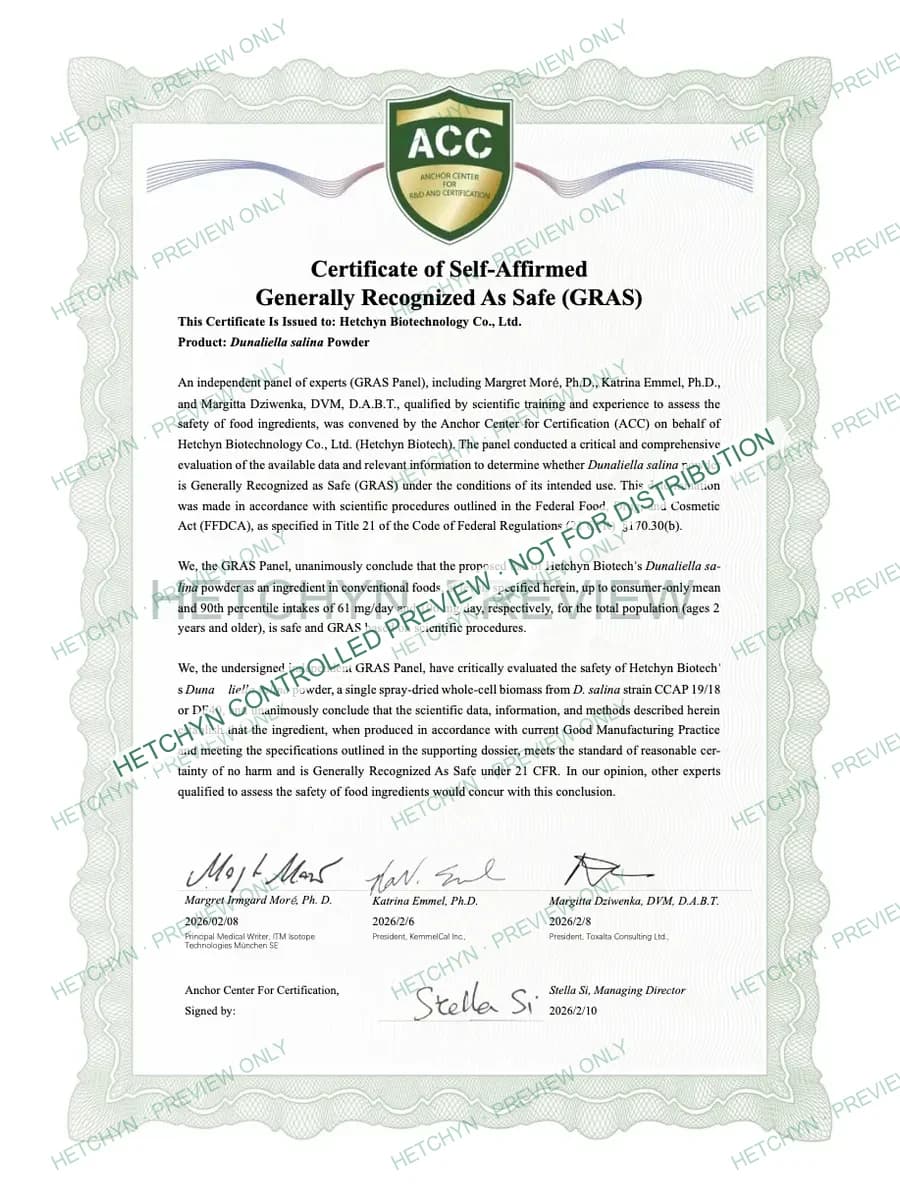
Powder-specific
Self-Affirmed GRAS
Dunaliella salina powder reviewed by an independent expert panel.
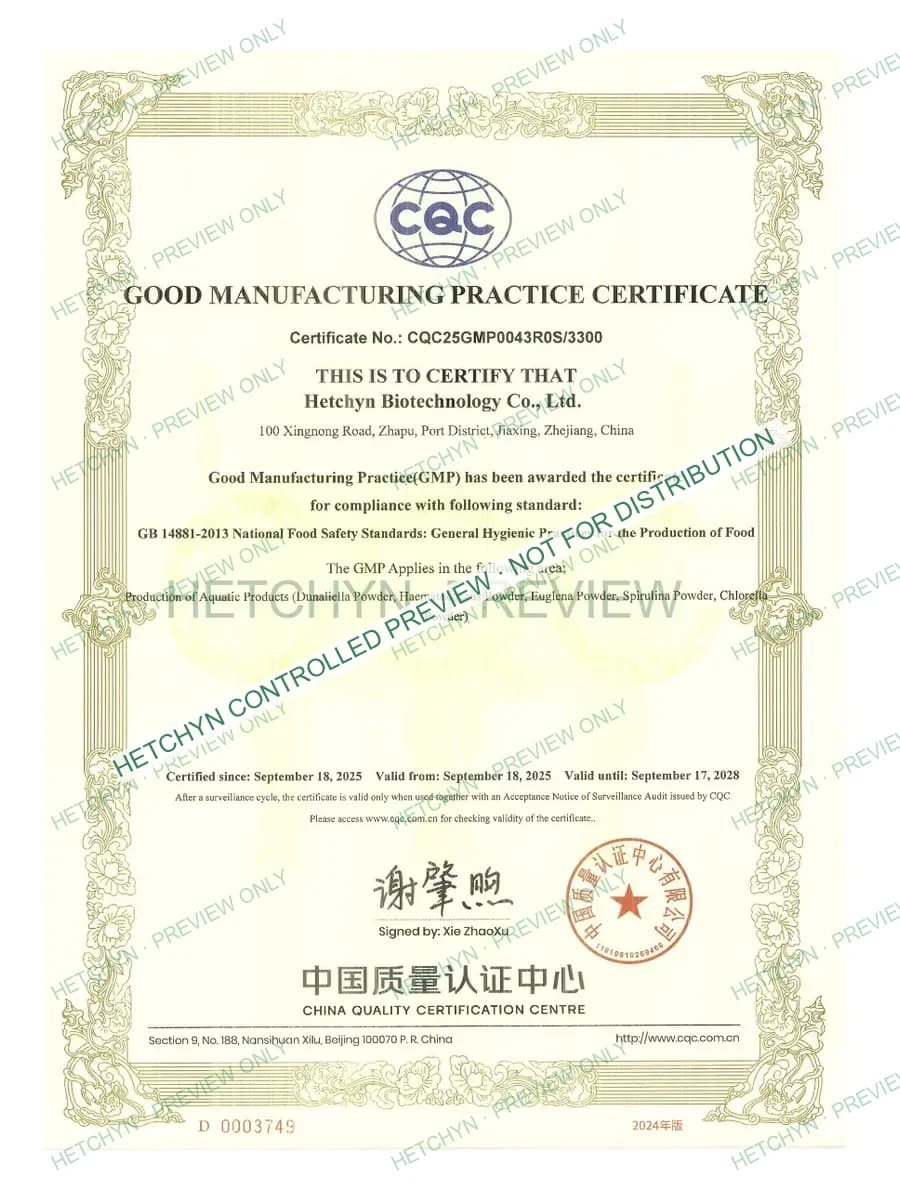
Manufacturing
GMP
Good manufacturing practice credential.
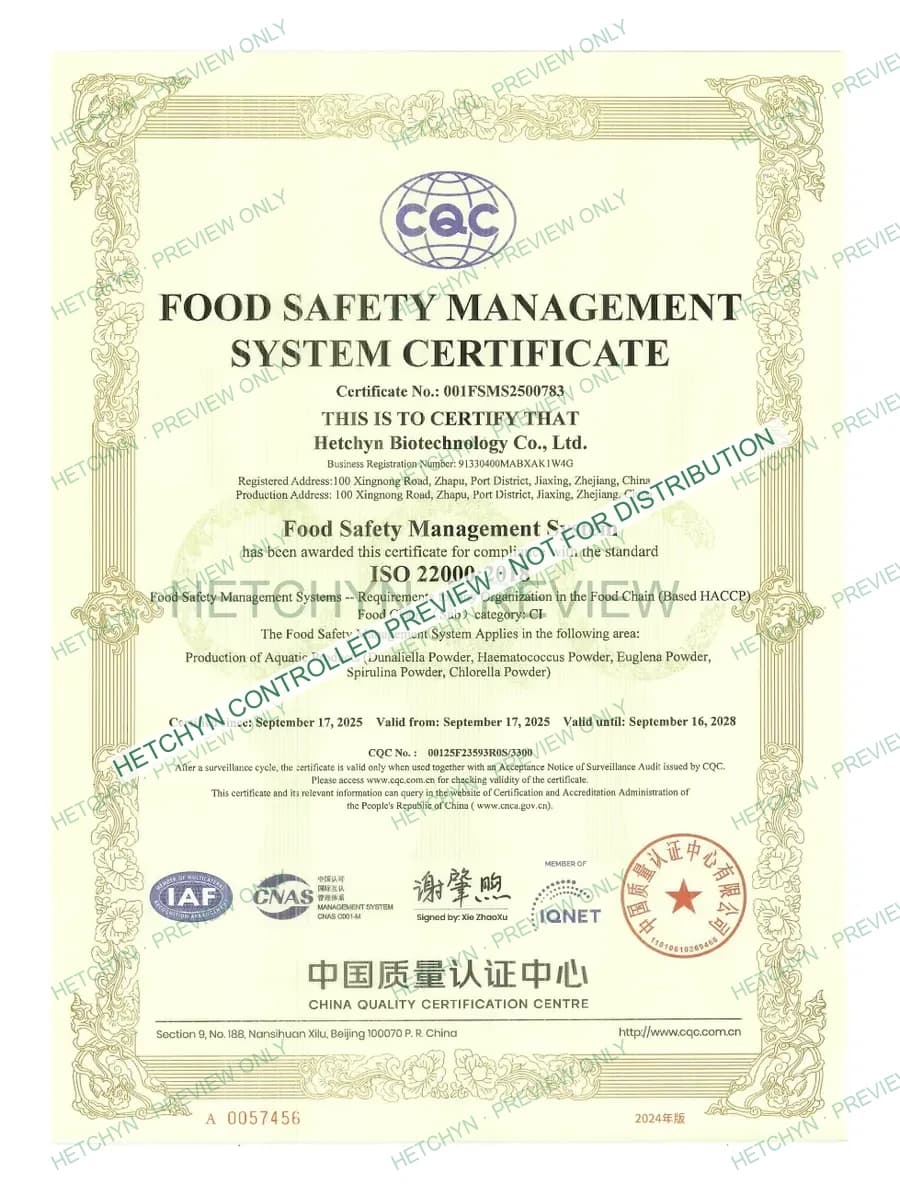
Food safety
ISO 22000
Food safety management system credential.
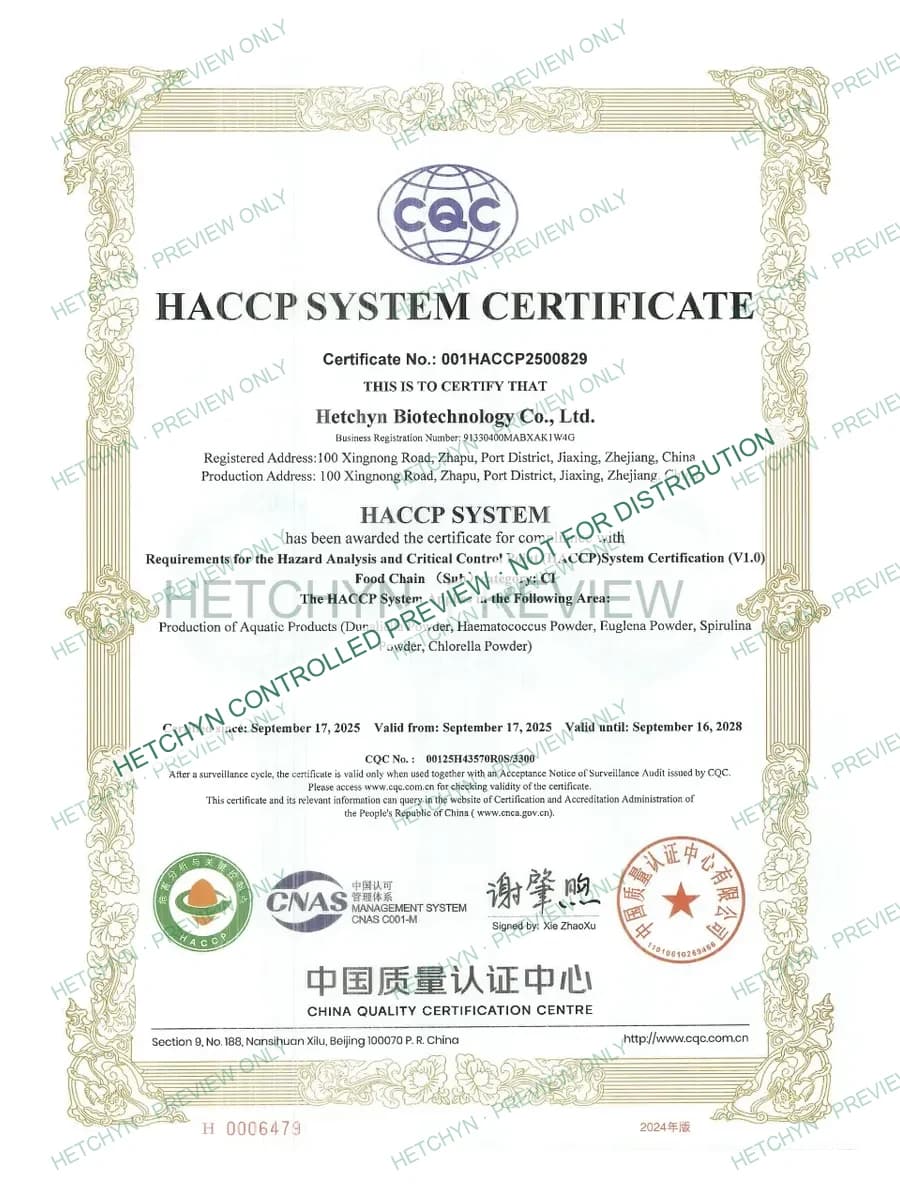
Hazard control
HACCP
Hazard analysis and critical control points credential.
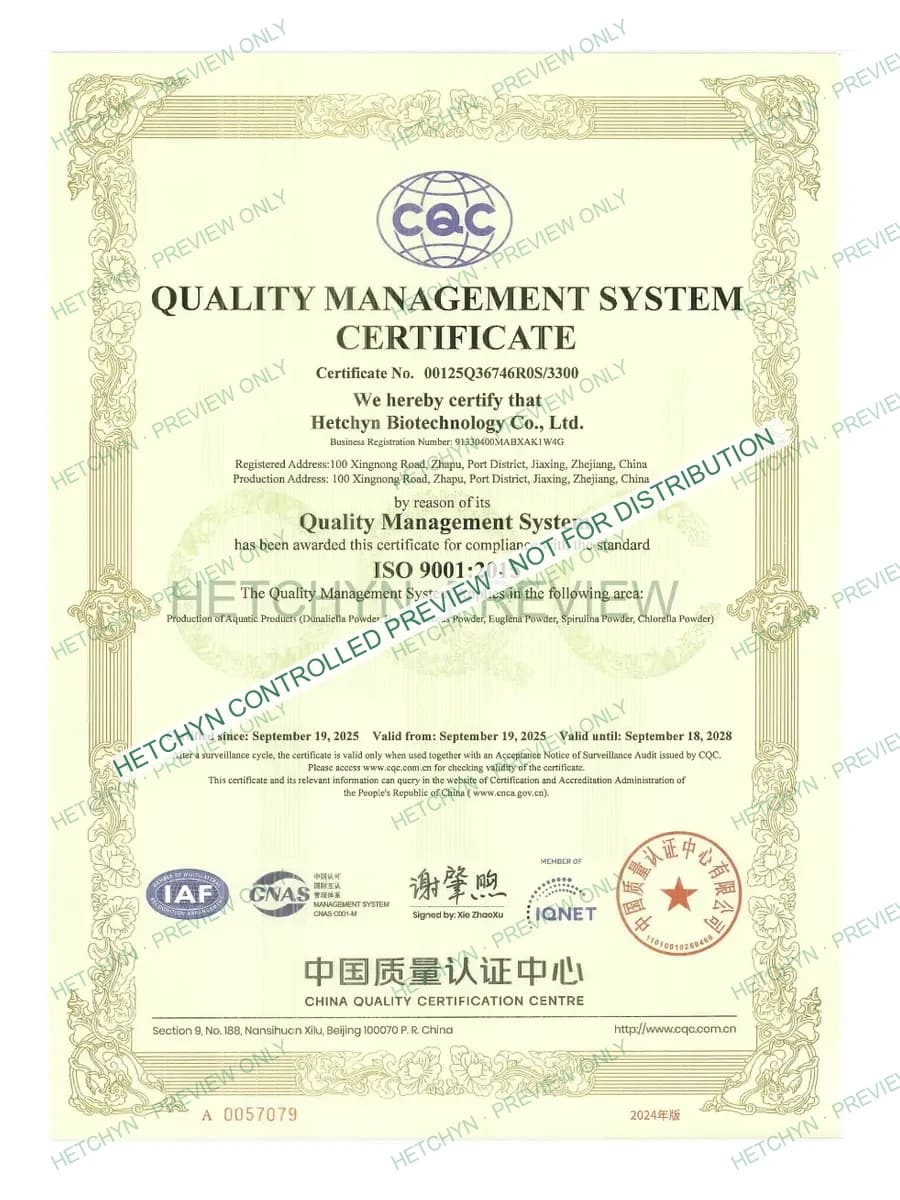
Quality management
ISO 9001
Quality management system credential.
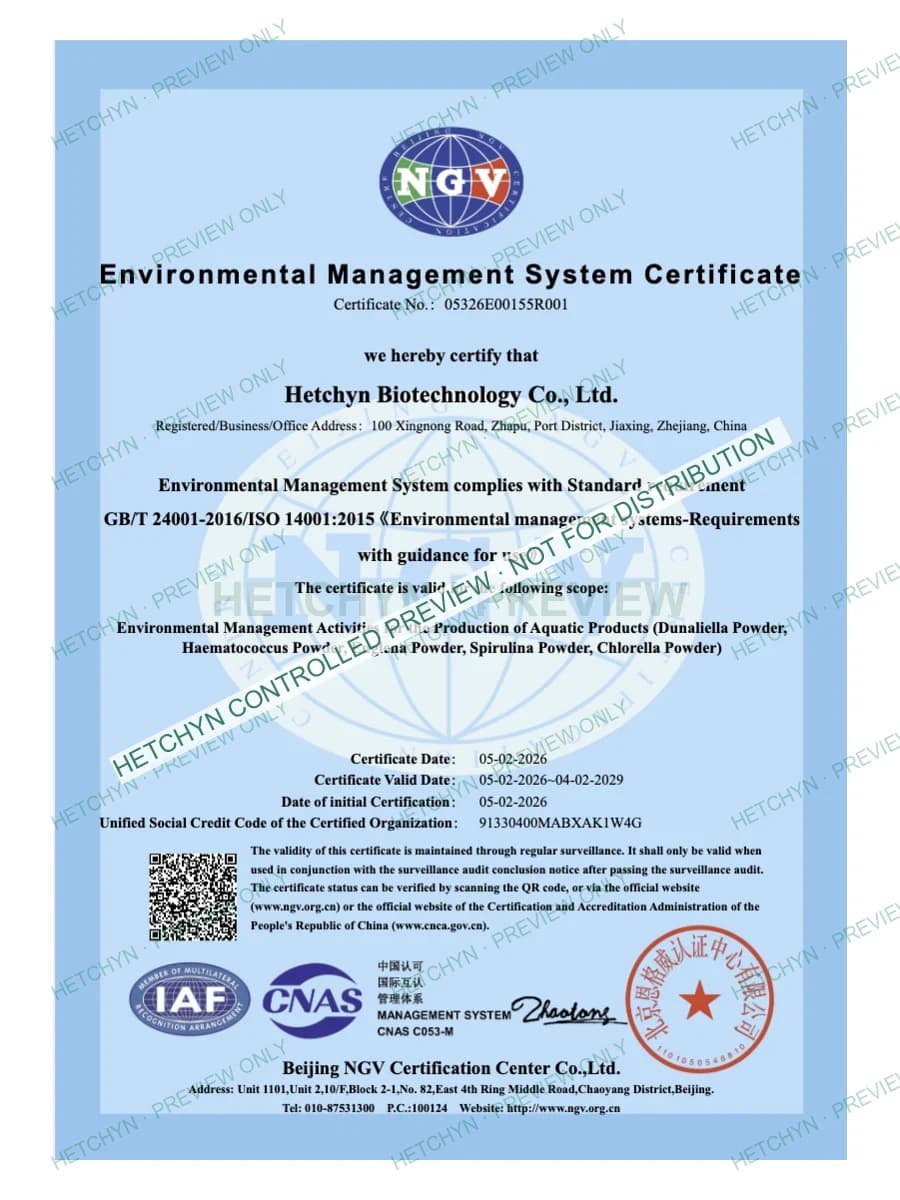
Environmental management
ISO 14001
Environmental management system covering production activities including Dunaliella powder.
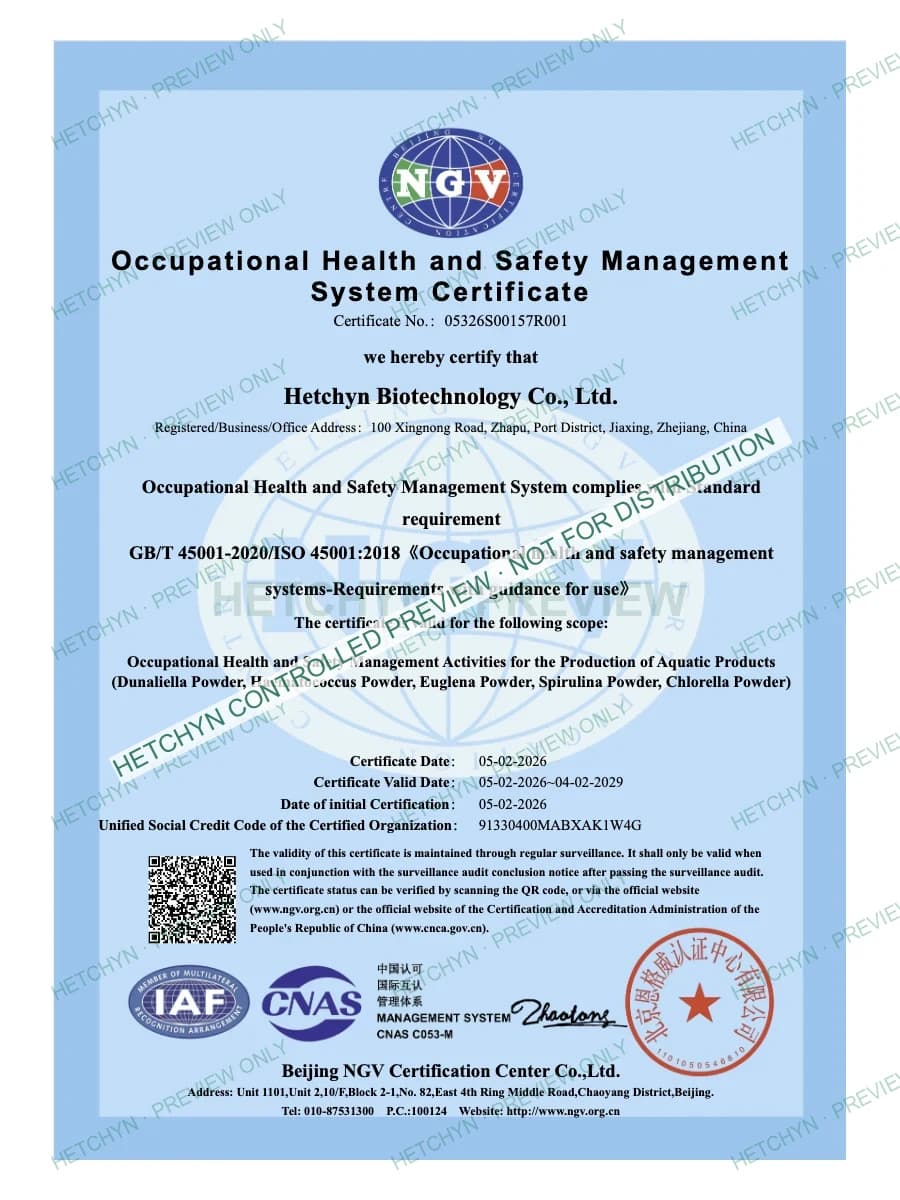
Occupational health & safety
ISO 45001
Occupational health and safety management system covering production activities including Dunaliella powder.
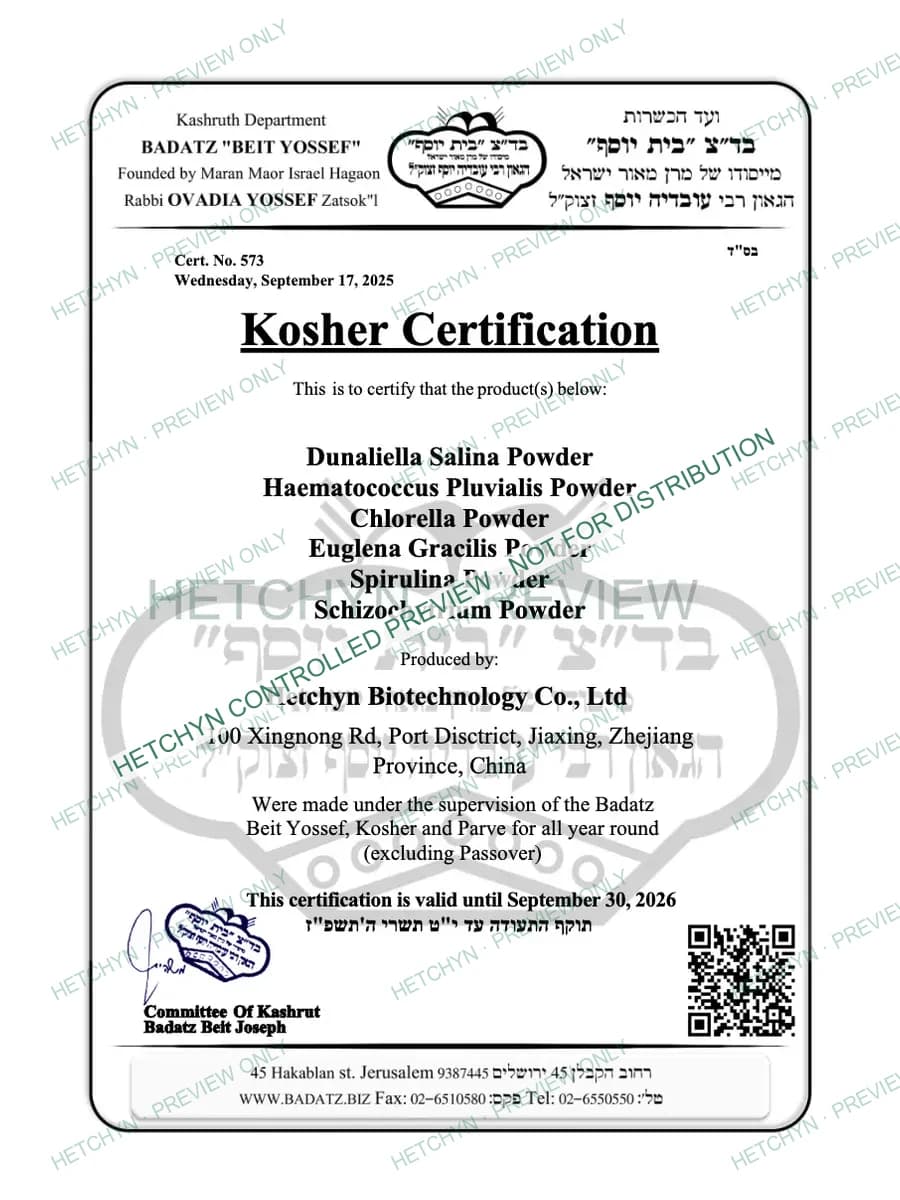
Product certification
Kosher
Certification covering Dunaliella salina powder.
Additional public credentials
These statuses complement the watermarked previews above. Sales confirms current scope and applicability during qualification.
- SC certification
- cGMP
- FDA
- Green Factory
Self-affirmed GRAS applies to Dunaliella salina powder. It should not be read as final FDA GRAS completion or as applying automatically to every product format.
Product documents
Request the quality documents for your selected grade.
Our team matches the current document revision to the product code, production route and batch context you need to review.
Request the document setProduct Specification
Current requirements, methods, storage conditions and release limits for the selected product code.
Representative COA
A clearly identified representative batch for initial technical and quality review.
SDS / MSDS
Safety, handling and storage information supplied for the applicable ingredient.
Certification evidence
Current certificate copies with scope, validity and product applicability confirmed by sales.
Quality FAQ
Questions to settle during technical qualification.
Use the same product code, parameter and evidence type throughout the review so requirements and batch results are not confused.
01What is the difference between a Product Specification and a COA?
The Product Specification defines tests, methods and release limits for a product code. A COA reports the measured results for one identified batch against those requirements.
02What total-arsenic limit applies to greenhouse-grown Dunaliella powder?
HETCHYN's current production control commitment for total arsenic is ≤0.5 mg/kg. Applicable greenhouse-grown powder specifications use a formal total-arsenic release limit of ≤1.0 mg/kg, and the selected batch result is reported on its COA.
03Are total arsenic and inorganic arsenic interchangeable?
No. They are different analytical parameters. A valid comparison must use the same parameter, unit and test method; an inorganic-arsenic result cannot be presented as a total-arsenic result.
04Does a representative COA guarantee every future batch?
No. It shows the measured result for the identified batch and supports initial evaluation. Each supplied batch is released against the applicable current specification and has its own batch documentation.
05Does one certificate cover every Carovive® format?
Not automatically. Each certificate has a defined holder, site, product or system scope. Applicability must be checked for the selected product code and destination market.
06How can a buyer obtain the current document set?
Provide the product code, application and destination market. HETCHYN sales or quality can then supply the current approved Product Specification, representative or batch COA, SDS / MSDS and applicable certificate copies.
Talk to our ingredient team
Tell us which grade your quality team is reviewing.
Share your application, target potency and market. We will help identify the most suitable starting grade.
Start an inquiry