
What it is
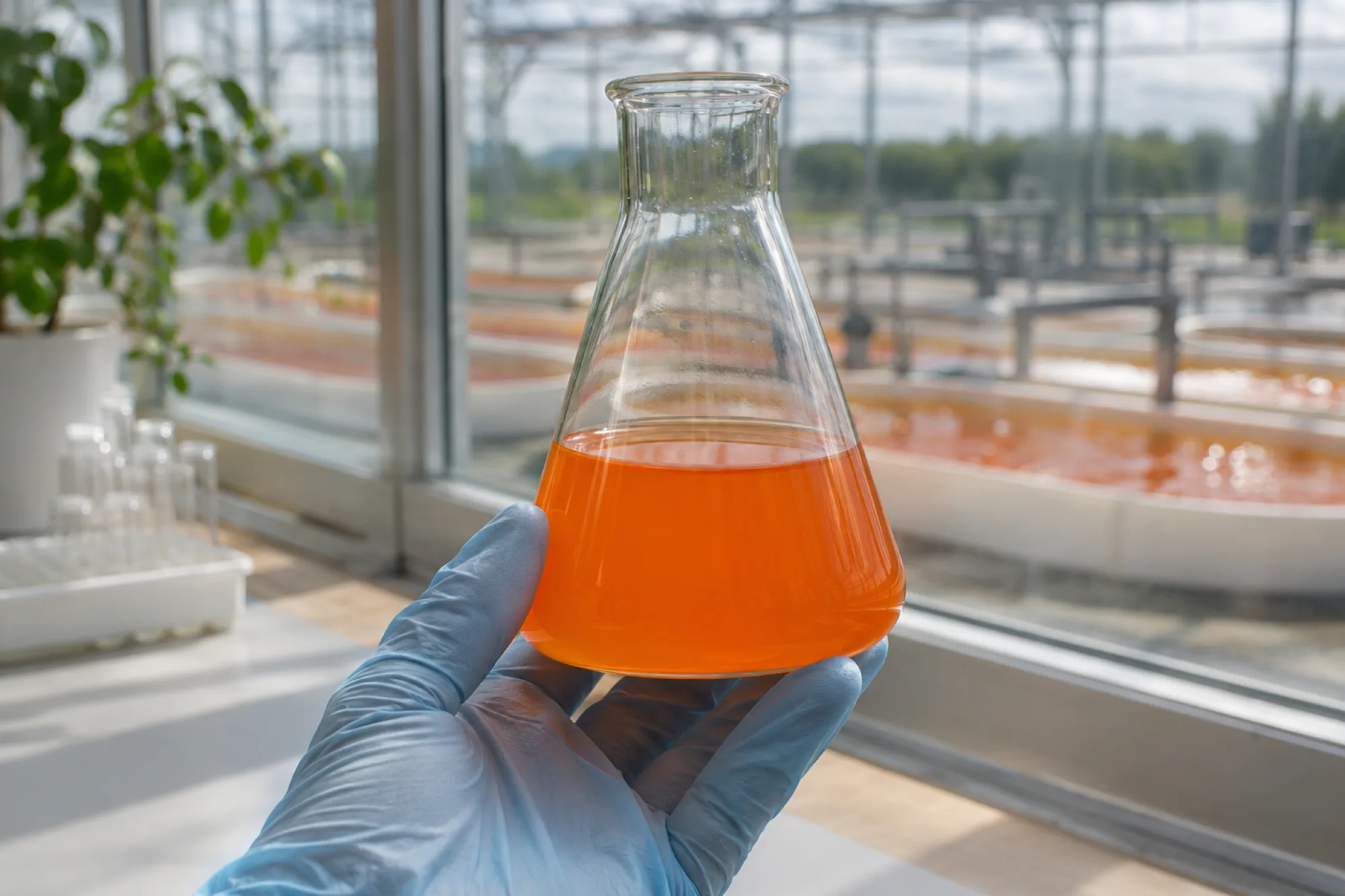
Dunaliella salina is a single-celled green alga that lives in high-salinity water such as salt lakes and evaporation ponds. It has no rigid cell wall, and it tolerates salt concentrations that most other algae cannot.
Why it turns orange
When the culture is stressed, for example by strong light, high salinity or limited nutrients, the cells build up carotenoids, and the culture changes from green to orange-red. Published work reports beta-carotene at about 10% or more of dry weight, with roughly equal parts all-trans and 9-cis isomers. Light stress can raise the 9-cis share further.
This is why grower control matters. Light, temperature, salinity, nutrients and circulation all shape what the biomass contains before it is dried or extracted.
What is in its beta-carotene
Synthetic beta-carotene is more than 98% all-trans. Dunaliella beta-carotene is reported at about 50% all-trans and more than 40% 9-cis. The exact ratio depends on the strain, the growing conditions and how the material is processed, so it should be read from the specification of the grade you buy.
Three formats from one source
| Format | How it is made | Content | Typical use |
|---|---|---|---|
| Whole-algae powder | Harvested, desalted, dried, milled and sieved | 2%, 5%, 7.5% | Tablets, hard capsules, dry blends |
| Beta-carotene oil | Extracted from the algae with ethyl acetate or supercritical CO₂ | 8%, 10%, 30% | Softgels, oil-phase systems |
| Beadlets | Oil emulsified with wall materials and spray dried | 2%, 8% | Drinks, gummies, powders |
Regulatory snapshot
In China, Dunaliella salina and its extract are a novel food under Ministry of Health Announcement No. 18 of 2009, and the beta-carotene extract also has a food-additive standard (GB 1886.317-2021). In the EU, Dunaliella salina is listed in the Novel Food Catalogue as not novel in food supplements; the catalogue is informative, and other food uses need a separate check. Always confirm the route for your finished product and market.
What this does not tell you
Research on Dunaliella, including our research library, describes the cited study. It does not show that a finished product has any particular effect. Ask for the specification and a representative COA for the exact grade you are evaluating.
Sources
- Harvey & Ben-Amotz (2020), Towards a sustainable Dunaliella salina microalgal biorefinery for 9-cis β-carotene production, Algal Research
- Antioxidants 2019, 8(5), 148: Dunaliella carotenoid accumulation and isomers
- European Commission: algae species in the Novel Food Status Catalogue
Product values are from HETCHYN specifications effective 2026-11-20. Reviewed by the HETCHYN Quality Department. Updated 2026-11-26.