
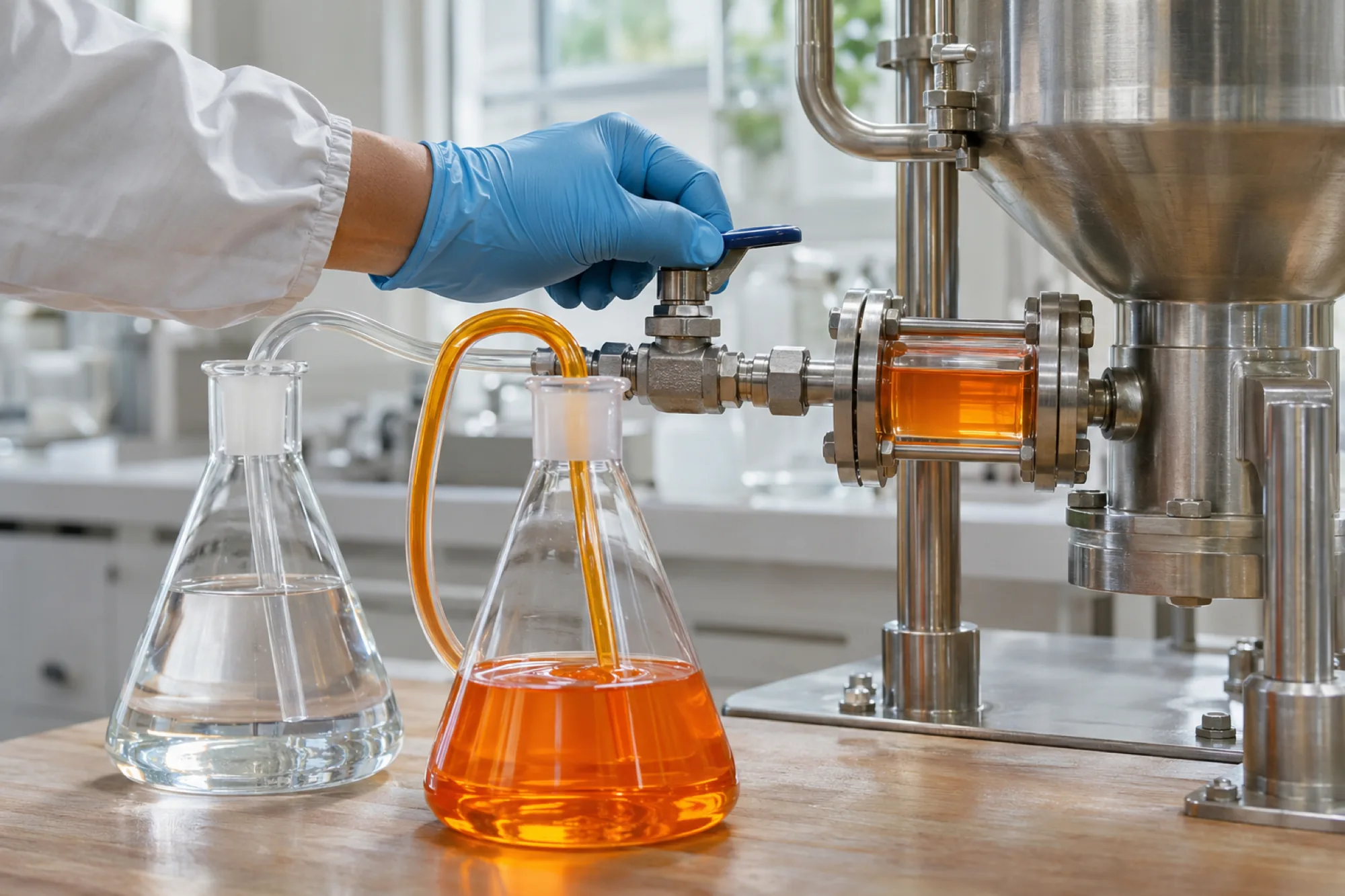
What HETCHYN offers on each route
| Ethyl acetate | Supercritical CO₂ | |
|---|---|---|
| Content | 8%, 10%, 30% | 8%, 10%, 30%, plus a high 9-cis type at 8% |
| Residual solvent | Ethyl acetate ≤30 mg/kg | No extraction solvent used |
| Grade tiers | Standard and Premium (EX) | Standard and Premium (EX) |
| Used as | Oil, and the source oil for beadlets | Oil, and the source oil for beadlets |
How to choose
- If your market or brand requires a process without an organic extraction solvent, choose a supercritical CO₂ code.
- If a residual ethyl acetate limit of 30 mg/kg is acceptable for your market, either route fits, and the choice can follow availability and specification.
- Premium (EX) grades carry tighter heavy-metal limits on either route, for example lead 0.5 mg/kg instead of 1.0 mg/kg.
What published studies say about supercritical CO₂
Supercritical CO₂ is non-toxic and leaves no organic solvent, and its selectivity can be tuned with pressure and temperature. Studies also note limits: pure CO₂ dissolves beta-carotene poorly, so ethanol is often added as a co-solvent, the biomass generally needs to be dry, and the equipment is expensive.
On economics the literature is mixed. One techno-economic analysis estimated lower cost per kilogram than hexane extraction but about twice the energy use. A life-cycle study found better energy and emissions results but a higher cost per kilogram because of lower yield. The answer depends on the assumptions, so we describe the trade-off rather than claim a winner.
These studies are about process design in general, not about HETCHYN's lines. The specification of the grade you buy is the document that states what you receive.
Sources
- Ludwig et al. (2021), Techno-economic analysis of β-carotene extraction from Dunaliella salina, J Appl Phycol
- Espada et al. (2020), Environmental and techno-economic evaluation of β-carotene production from Dunaliella salina, Biofuels Bioprod Bioref
- Harvey & Ben-Amotz (2020), Towards a sustainable Dunaliella salina microalgal biorefinery for 9-cis β-carotene production, Algal Research
Product values are from HETCHYN specifications effective 2026-11-20. Reviewed by the HETCHYN Quality Department. Updated 2026-11-26.