
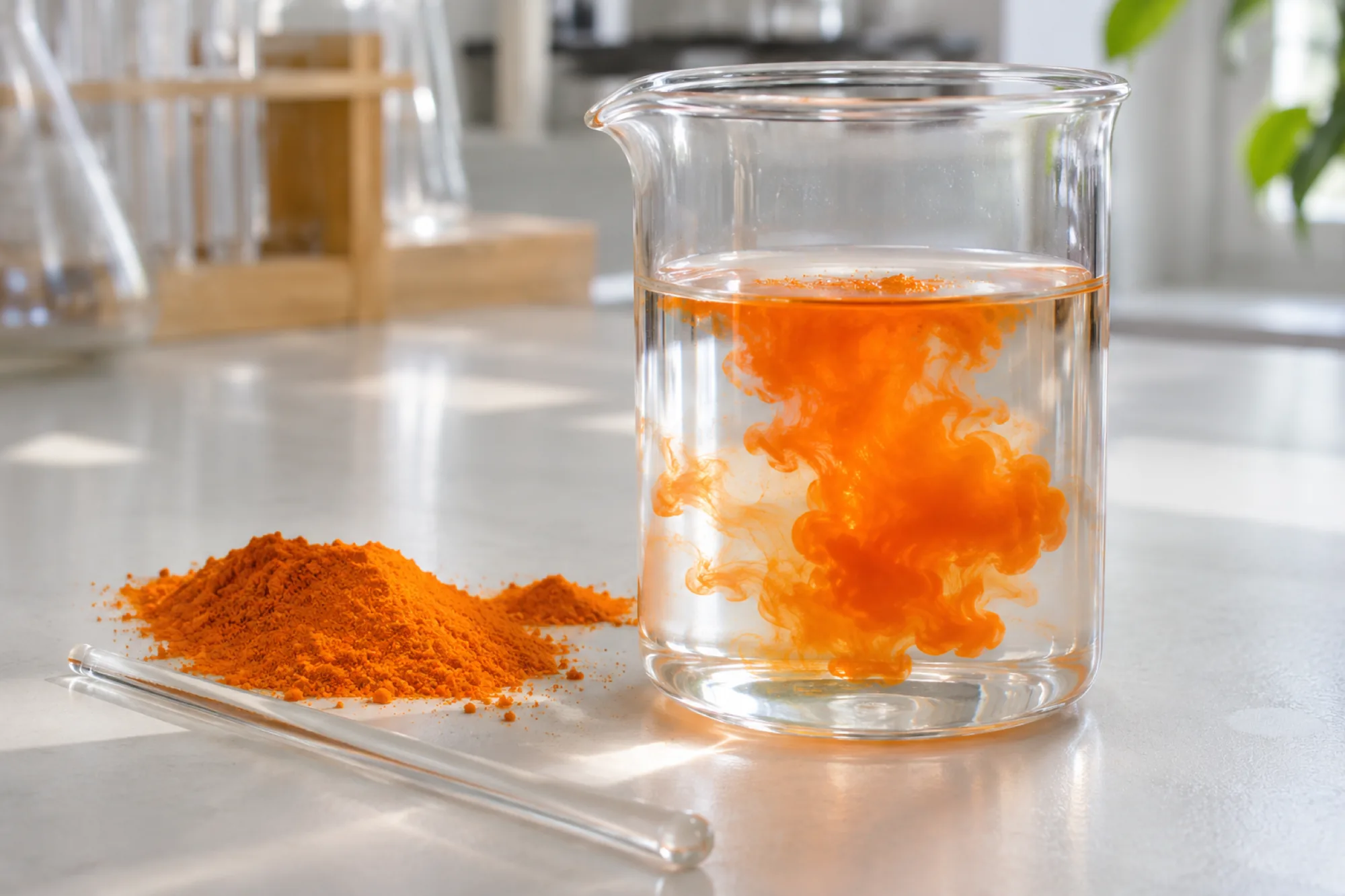
What beadlets are
Beadlets start from Dunaliella beta-carotene oil. The oil is emulsified, homogenised and blended with wall materials, then spray dried and sieved. The result is a powder that disperses in water-based systems, which a plain oil does not.
What the specification says
| Item | Value |
|---|---|
| Beta-carotene content | 2% or 8% minimum, by code |
| Oil source | Ethyl acetate route (RE) or supercritical CO₂ route (SE); one high 9-cis code (SE, 2%) |
| Wall materials | Sodium starch octenyl succinate, maltodextrin, gum arabic |
| Appearance | Orange to brown free-flowing powder, no lumps |
| Particle size | At least 95% passes 80 mesh |
| Moisture, ash | Moisture ≤5.0%, ash ≤5.0% |
| Lead, total arsenic | Lead ≤1.0 mg/kg, total arsenic ≤1.0 mg/kg |
| Shelf life | 24 months unopened, original packaging |
How to choose a code
- Pick 2% or 8% to match the beta-carotene dose per serving in your design.
- Pick the oil route (RE or SE) by the same residual-solvent logic as the oil: the SE route uses no organic extraction solvent.
- Choose the high 9-cis code only if your brief specifies it.
- Check that the wall materials suit your labelling and any allergen or dietary requirements in your market.
What to test in your own system
A specification cannot predict behaviour in your formula. Plan bench tests for dispersion, colour, stability through your process temperatures, pH, light exposure and shelf life in the finished form, and share your results with us so we can advise on the next step.
Order and documents
The minimum order for beadlets is 200 kg. Ask for the specification and a representative COA for your code, and for samples where you need them.
Product values are from HETCHYN specifications effective 2026-11-20. Reviewed by the HETCHYN Quality Department. Updated 2026-11-26.